
TL;DR
Addiction treatment manages a chronic condition. It does not cure it, so the plan for after discharge matters as much as the stay itself.[1]
A good rehab facility in Orange County starts your aftercare plan during treatment, not on the last day.
A relapse prevention plan names your triggers, your early warning signs, and the specific things you will do when each one shows up.
Relapse does not mean treatment failed. It is a signal to resume, change, or add treatment.[1]
Families help most by learning the plan, keeping the home steady, and knowing what to do if things slip.
Table of Contents
What a rehab facility in Orange County includes in an aftercare plan
Ongoing support: outpatient care, therapy, medication management, and peer groups
Introduction
The last week of treatment is often the most frightening one. The structure that held your days together is about to end, and you are going back to your own kitchen, your own phone, your own commute.
That fear is reasonable, and an aftercare plan exists to address it. At a rehab facility in Orange County, preparing for life after treatment begins well before discharge. This article explains what that plan contains, how a relapse prevention plan is built, and where you and your family fit in. If you are still deciding whether treatment is right, our guide on signs it may be time to consider an Orange County rehab program is a better place to start.
Why recovery doesn't end when treatment does
The National Institute on Drug Abuse (NIDA) puts it plainly: addiction treatment is not a cure, but a way of managing the condition, much like treatment for heart disease or asthma.[1] Treatment helps you counteract addiction's effects on your brain and behavior and take back control of your life.
The National Institute on Alcohol Abuse and Alcoholism (NIAAA) adds that lasting changes in the brain from alcohol misuse make people vulnerable to relapse.[2] The same source also says that behavioral therapies, mutual-support groups, and medications can help people reach and keep recovery, however severe the problem seems.[2]
So the weeks and months after discharge are part of the treatment, not an epilogue. A rehab facility in Orange County that sees it this way will talk about your plan from the first week.

What a rehab facility in Orange County includes in an aftercare plan
An aftercare plan is a written schedule of support for the months after you leave. It is not a brochure. It has names, dates, and phone numbers.
The American Society of Addiction Medicine (ASAM) Criteria describe a standard way to assess a person's medical, psychological, and social needs, build an individualized treatment plan, and match the person to the right level of care.[3] Aftercare planning follows the same logic: it steps you down to the level of support you need now, and it can step you back up.
A typical plan from a rehab facility in Orange County covers:
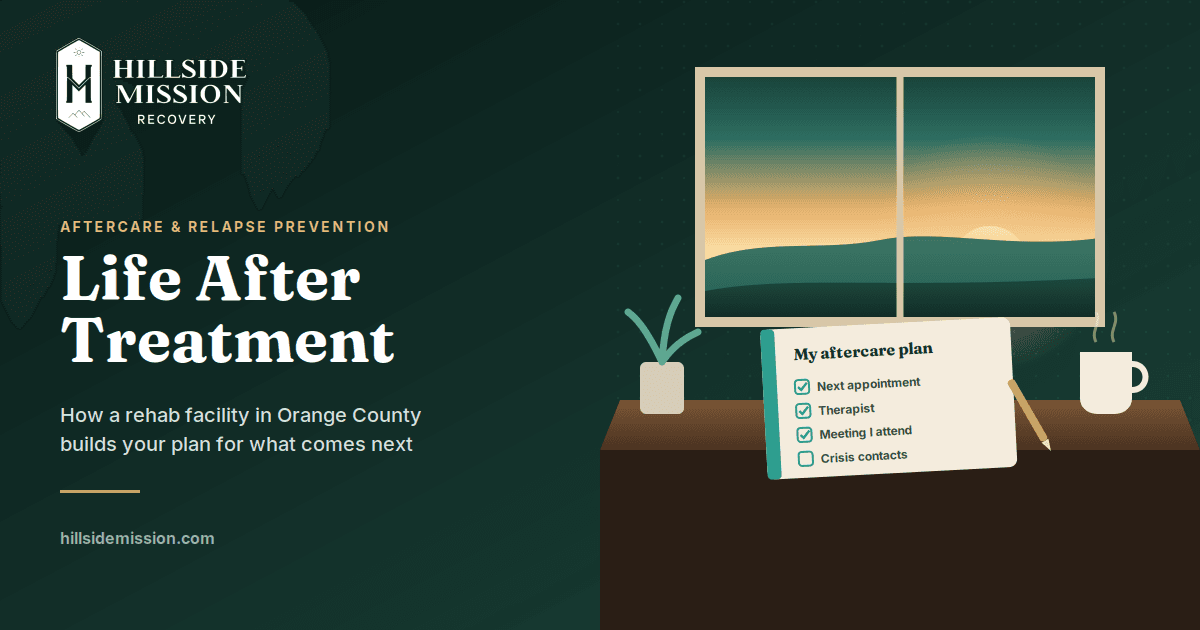
Your next level of care and the date it starts, so there is no gap between discharge and your first appointment.
Therapy appointments, with a named clinician.
Medication follow-up, if you take any.
Peer support meetings you have already attended at least once.
A housing plan for your first months.
A crisis list: who to call at 2 a.m., and in what order.
At Hillside Mission Recovery, this work connects to the Aftercare & Alumni program, which continues after your residential inpatient stay ends. If you want to compare step-down options, see our post on intensive outpatient versus outpatient rehab.

Building a personalized relapse prevention plan
A relapse prevention plan is a document you write with your treatment team. It answers three questions: what puts me at risk, how will I know I am slipping, and what will I do about it?
Generic plans fail because risks are personal. Someone who drank after work every day has a different Friday than someone who used alone at night. Your plan should be built from your own history, which is why the ASAM approach starts with an individual assessment.[3]
If you also live with depression, trauma, or anxiety, the plan has to address those too. The NIAAA notes that conditions such as depression, post-traumatic stress disorder, and ADHD are linked with increased risk of alcohol use disorder.[2] That is why Hillside Mission Recovery offers dual diagnosis treatment, and why mental health care belongs inside the plan.

Identifying triggers, warning signs, and coping skills
These three pieces work as a chain. A trigger is the situation that sets off a craving. A warning sign is the change in your thinking or behavior that shows up before use. A coping skill is what you do in between.
Piece | What it is | Example | Planned response |
|---|---|---|---|
Trigger | Person, place, feeling, or event that raises craving | Payday, or an argument with a partner | Leave the situation, call a sponsor or friend |
Warning sign | Early shift before use | Skipping meetings, isolating, poor sleep | Tell your therapist that week, add a session |
Coping skill | Action that lowers risk in the moment | Urge surfing, a walk, a scheduled call | Practice it before you need it |
Write the warning signs down, and give a copy to one person you trust. You are often the last to notice your own slide.
One more point matters for safety. NIDA warns that for some drugs relapse can be deadly: a person who uses as much as they did before quitting can easily overdose.[1] Tolerance drops during treatment. Families of people recovering from opioid use should read our step-by-step Narcan guide and keep naloxone at home. Our explanation of why fentanyl is so much more potent shows why the stakes are high.

Ongoing support: outpatient care, therapy, medication management, and peer groups
Support after discharge usually has four parts, and most people use more than one.
Outpatient care: scheduled sessions while you live at home or in sober housing. Hours taper as you stabilize.
Individual and group therapy: behavioral therapy is one of the treatments the NIAAA lists as helping people maintain recovery.[2]
Medication management: if medication is part of your care, regular check-ins keep doses right and catch side effects.
Peer groups: mutual-support groups put you in a room with people who know the early months firsthand.
SAMHSA runs a National Helpline and the FindTreatment.gov locator, both useful if you need to find or change a provider after you leave.[4] The same page also links to the 988 Suicide & Crisis Lifeline, which you can call or text at any hour.[4]

Sober living and community resources in Orange County
Where you sleep in the first months matters. Going straight back to a house where people drink or use is one of the hardest ways to begin. Sober living gives you a substance-free home, house rules, and neighbors who are working on the same thing.
Your discharge team at a rehab facility in Orange County can help you weigh options such as sober living, a family home with agreed rules, or a return to your own place with added support. Ask each house about curfews, drug testing, costs, and what happens if someone slips.
Beyond housing, build a week with structure: work or school, meetings, exercise, and time with people who support your recovery. Alumni groups through Hillside Mission Recovery's alumni program are one way to stay connected to people who already know your story.
How families can support life after treatment
Families are not responsible for someone's recovery, but they shape the home it happens in. Ask to see the relapse prevention plan, or at least the parts your family member is willing to share. Learn the warning signs on it.
Keep alcohol and unused medication out of shared spaces if your family member asks.
Agree ahead of time on what you will do if you see a warning sign.
Keep naloxone in the home if opioids were involved.
Look after your own health, and consider a family support group.
Our article on supporting a loved one through rehab in Orange County goes deeper on boundaries and self-care.
Frequently Asked Questions
Q: What is an aftercare plan, and when should it be created during rehab?
A: An aftercare plan is a written schedule of therapy, medication follow-up, peer support, housing, and crisis contacts for after you leave. It should start early in treatment and be finalized before discharge, so your first appointment is already booked.
Q: How does a rehab facility in Orange County create a relapse prevention plan?
A: Your clinicians assess your medical, mental health, and social needs, then work with you to list your triggers, early warning signs, and coping steps.[3] The plan is personal and gets updated as your life changes.
Q: How long should someone stay engaged in aftercare after completing treatment?
A: There is no single number in the sources we cite. Because addiction is a chronic condition managed over time, many people stay in some form of support long term, with fewer hours as they stabilize.[1] Your treatment team can set a schedule for you.
Q: Does relapse mean treatment has failed?
A: No. NIDA says relapse rates for substance use disorders are similar to those for other chronic illnesses, and that relapse is a sign to resume, modify, or try a different treatment.[1] Call your provider quickly, and take overdose risk seriously.
Q: What role can family members play in aftercare and relapse prevention?
A: Families can learn the warning signs, keep the home steady, keep naloxone available when opioids are a concern, and know who to call if things slip. They can also get support for themselves.
Conclusion
Finishing treatment is a beginning. A strong rehab facility in Orange County gives you more than a discharge date. You leave with a named next step, a plan for your triggers, a place to live, and people to call. If you slip, the plan tells you what to do next instead of leaving you to start over alone.
If you or someone you love is close to finishing treatment, or is looking for a rehab facility in Orange County that plans for life afterward, Hillside Mission Recovery can talk through your situation. Visit hillsidemission.com or read about what to expect in drug rehab in Orange County. If you need medical detox before anything else, we can start there.
References
National Institute on Drug Abuse. Treatment and Recovery. Drugs, Brains, and Behavior: The Science of Addiction. - https://nida.nih.gov/publications/drugs-brains-behavior-science-addiction/treatment-recovery
National Institute on Alcohol Abuse and Alcoholism. Understanding Alcohol Use Disorder. - https://www.niaaa.nih.gov/alcohols-effects-health/alcohol-use-disorder
American Society of Addiction Medicine. (2023). The ASAM Criteria, Fourth Edition. - https://www.asam.org/asam-criteria
Substance Abuse and Mental Health Services Administration. Recovery and Support. - https://www.samhsa.gov/find-help/recovery
Ready to take the next step?
If you or someone you love is struggling, Hillside Mission is here to help — confidentially, 24/7.